
The macaque remains found in Antalya during the Roman period shed light on ancient trade networks
Date | 14 September 2026, Monday

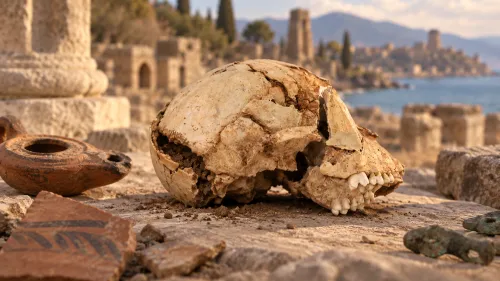
The approximately 1800-year-old primate skull found in the ancient necropolis of Attaleia in Antalya provided remarkable clues about the trade networks through which exotic animals were transported across the Mediterranean during the Roman period. Detailed examinations revealed that the remains belong to the genus Macaca and are likely closely related to Macaca sylvanus, which is of North African origin.
The skull was found in a reused grave from the Roman period and is dated to the late 2nd century to early 3rd century. Researchers determined through comparisons based on dental structure and measurements that it likely belonged to a young macaque.
One of the most striking aspects of the study is that this animal is not a species that naturally lived in Anatolia. Researchers consider that the animal may have been brought to the region by sea in ancient times, taking into account Attaleia's position within Mediterranean trade networks and its connections to North Africa.
In the Roman world, macaques were used not only as exotic animals but also sometimes as pets, show animals, mascots, or symbols of high status. The fact that the remains were found in a human grave raises the possibility of a close relationship with its owner. However, it is emphasized that this cannot be definitively stated due to the unknown original position of the skull within the grave.
This research is the first study in Turkey to conduct a detailed osteological and morphometric analysis of an archaeological macaque remains. The findings provide a new contribution to the understanding of exotic animal trade and human-animal relationships in ancient Anatolia.
The study was published in the International Journal of Osteoarchaeology.
Article access link:
https://doi.org/10.1002/oa.70148