
Support for learning fractions with virtual reality
Date | 14 September 2026, Monday

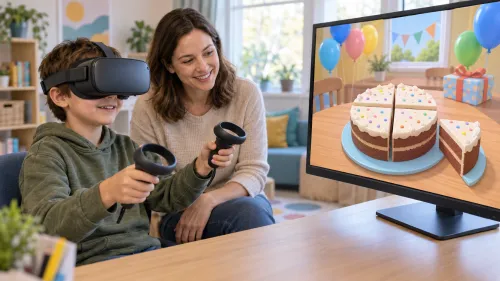
Slicing cake at a virtual birthday party turned into a math activity for children with learning difficulties. In a study conducted with a small group of students, significant progress was observed in learning fractions after individual education supported by virtual reality.
The research, which involved 10 students attending the third and fourth grades from two primary schools in Antalya, was supported by Burdur Mehmet Akif Ersoy University. Five of the students participated in individual activities supported by virtual reality for six weeks, while the other five followed the existing math program in their classrooms.
Children entering the game environment with virtual reality glasses worked on concepts like whole, half, and quarter through three-dimensional objects. Activities such as dividing cakes into equal parts and matching fractions with visuals concretized abstract mathematical concepts. Guidance was provided within the application when students struggled or made mistakes.
At the end of the application, the success scores of the virtual reality group were found to be higher than those of the comparison group. An evaluation conducted about seven weeks later in the virtual reality group also showed that a large portion of what was learned was retained. Student and family feedback indicated positive changes in interest in mathematics, desire to learn, and self-confidence.
Progress was particularly evident in tasks such as representing fractions with shapes and understanding visual models. However, the development in transferring what was learned to everyday life problems remained more limited. This result suggests that activities conducted in a virtual environment should be supported with different problems and examples from daily life.
The research is a preliminary study conducted with a small number of students. Due to the one-on-one training provided to the virtual reality group, the contributions of technology and personal teaching support to the observed development cannot be separately identified. The findings provide a starting point for studies to be conducted with larger student groups.
The study was published in the International Journal of Science and Mathematics Education.
Article access link
https://doi.org/10.1007/s10763-025-10636-w